
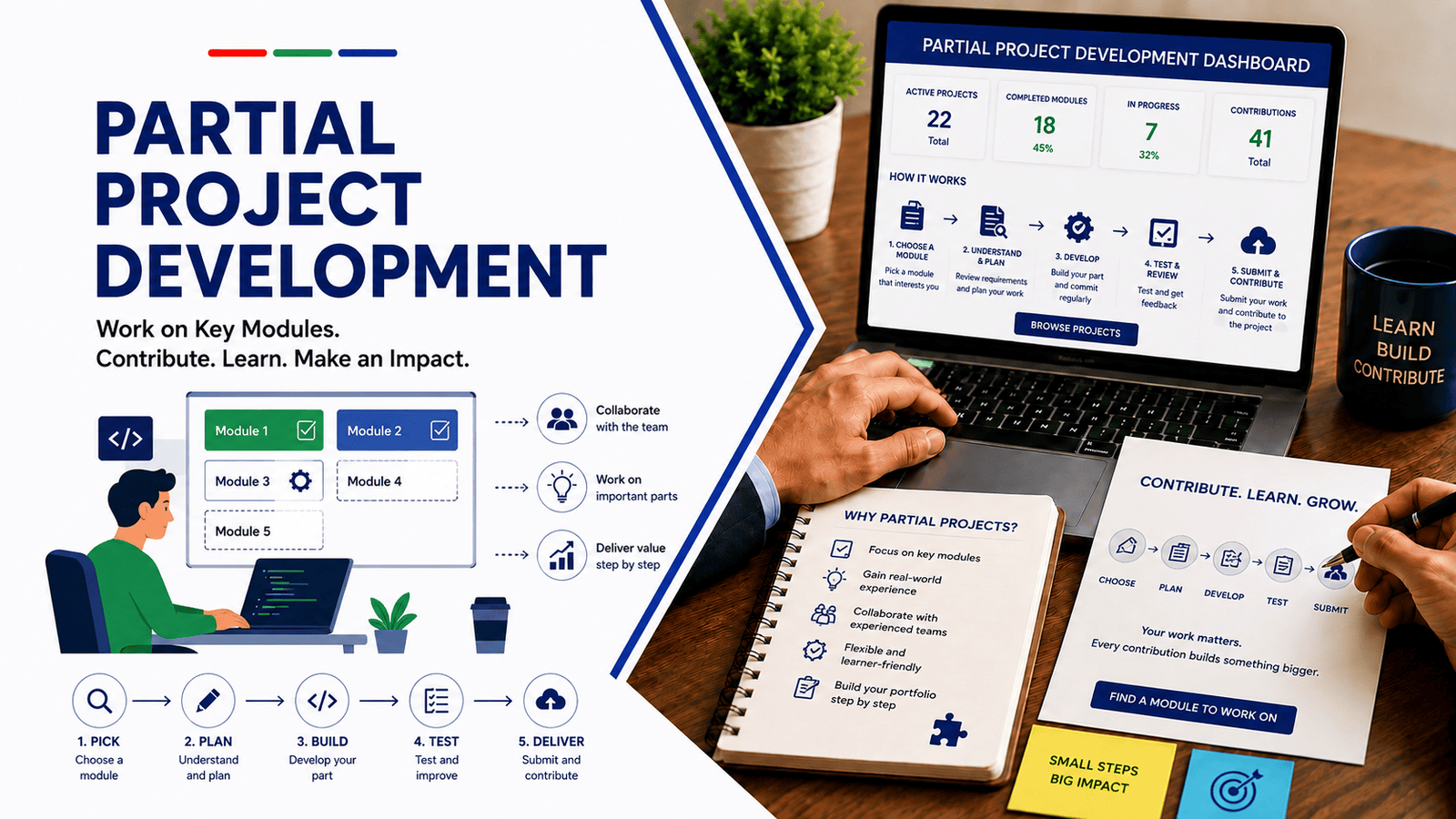
Partial Project Development Services
Accelerate Development with Focused Technical Execution
SRNTS provides Partial Project Development Services for startups, growing businesses, mid-sized organizations, and enterprise companies that require support for specific modules, features, integrations, enhancements, or selected areas within an ongoing project without outsourcing the complete project lifecycle.
Many organizations already have internal teams, implementation partners, or ongoing projects but frequently face situations where additional support is required in specific areas because of timeline pressure, resource limitations, skill gaps, or increasing project complexity.
Rather than hiring additional permanent resources or handing over the complete project, organizations can engage SRNTS to take ownership of a well-defined scope and deliver it independently with quality and speed.
Typical business situations include:
Internal team bandwidth limitations
Delayed project timelines
Short-term development requirements
Specialized skill requirements
Complex module implementation
Temporary increase in workload
Pending feature development
Integration challenges
Product enhancements and customizations
Resource unavailability
SRNTS provides a flexible development model where organizations can assign a specific portion of their project and our team takes complete responsibility for planning, execution, quality validation, and delivery.
Whether the requirement involves a single feature, complete module ownership, integrations, automation development, or enhancement work, SRNTS ensures that the assigned scope is delivered within agreed timelines while maintaining quality standards.
The objective of SRNTS Partial Project Development Services is to help organizations:
Accelerate delivery timelines
Reduce project bottlenecks
Access specialized expertise
Optimize operational costs
Increase delivery efficiency
Improve overall project quality
Our Development Philosophy
One of the strongest differentiators of SRNTS is our optimized delivery and resource allocation strategy.
Traditional organizations often assign similar resource structures across all project activities, which can increase overall costs without necessarily improving delivery efficiency.
SRNTS follows a smarter approach:
Assign the right resource to the right work while balancing quality, expertise, productivity, and cost efficiency.
Our execution model focuses on intelligent resource utilization:
Low Complexity Activities
Handled by:
Junior professionals
Optimized-cost resources
Examples:
Basic development activities
Standard configurations
Documentation work
Simple enhancements
Medium-Complexity Activities
Handled by:
Experienced developers
Examples:
Module development
API implementation
Business logic implementation
High Complexity Activities
Handled by:
Senior developers
Architects
Specialized experts
Examples:
Solution architecture
Complex integrations
Performance optimization
Critical implementations
This approach enables SRNTS to provide:
High-quality output
Better productivity
Faster execution
Reduced project costs
Improved ROI
Rather than focusing on large profit margins, SRNTS focuses on creating long-term customer relationships through quality delivery and value-driven execution.
Scope of Partial Project Development Services
Organizations can engage SRNTS for specific portions of their projects.
Module Development
Feature Development and Enhancements
Examples:
New functionality implementation
Existing feature enhancements
UI improvements
Additional business requirements
API and Integration Development
Examples:
Third-party integrations
API development
ERP integrations
CRM integrations
Cloud service integration
Automation and Workflow Solutions
Examples:
Approval workflows
Business process automation
Notification systems
Scheduled jobs
Issue Resolution and Optimization
Examples:
Performance improvements
Bug fixing
Code optimization
Technical improvements
Migration and Upgrade Support
Examples:
Platform migration
Environment migration
Feature migration
Version upgrades
Technologies Supported
SRNTS provides development services across multiple technologies and platforms.
Microsoft Technologies
Examples include:
Power Platform
Dynamics 365
Azure Services
.NET Technologies
Development Technologies
Examples include:
Java
Python
C#
Web technologies
Cloud and Integration Technologies
Examples include:
Azure Integration Services
API Management
Cloud solutions
Automation technologies
Enterprise Application Development
Examples include:
Custom business applications
Workflow systems
Enterprise platforms
Automation solutions
Key Benefits of Partial Project Development Services
Pay Only for What You Need
Organizations do not need to outsource the entire project.
Benefits include:
Better budget utilization
Lower development cost
Improved financial flexibility
Faster Project Completion
Dedicated ownership of specific modules helps reduce delays.
Benefits include:
Faster development cycles
Reduced bottlenecks
Improved productivity
Access to Specialized Expertise
Organizations gain access to:
Experienced developers
Technical specialists
Solution architects
Integration experts
High-Quality Deliverables
SRNTS follows structured development practices including:
Secure coding standards
Performance optimization
Scalability considerations
Industry best practices
Flexible Engagement Model
Organizations can outsource:
Individual modules
Features
Integrations
Enhancements
Complete work packages
Reduced Management Overhead
SRNTS takes ownership of:
Planning
Development
Progress tracking
Testing
Delivery
allowing organizations to focus on core business priorities.
Project Engagement Process
SRNTS follows a structured process to ensure smooth execution and delivery.
Step 1: Requirement Discussion
Organizations can connect with SRNTS and provide:
Scope details
Functional requirements
Technical expectations
Timelines
Business priorities
Step 2: Scope Analysis and Technical Review
SRNTS evaluates:
Technical complexity
Estimated effort
Resource requirements
Timeline feasibility
Step 3: Estimation and Proposal Sharing
SRNTS provides:
Scope understanding
Development approach
Timeline estimates
Budget estimates
Deliverable planning
Step 4: Scope Finalization and Agreement
After approval:
Scope is finalized
Deliverables are documented
Milestones are agreed
Step 5: Team Allocation and Development Kickoff
SRNTS assigns resources according to:
Skill requirements
Complexity level
Delivery expectation
Step 6: Development and Progress Monitoring
During execution:
Regular progress updates are shared
Milestone tracking is performed
Discussions and feedback sessions are conducted
Step 7: Testing, Validation, and Delivery
Before completion:
Quality checks are performed
Testing activities are completed
Deliverables are validated
Pricing for Partial Project Development
High-Quality Project Delivery at Competitive Pricing
One of the biggest challenges organizations face while implementing Power Platform, Dynamics 365, Azure, and custom business applications is managing project costs without compromising quality.
At SRNTS, we have developed a unique project delivery model that enables us to provide high-quality solutions at significantly lower costs compared to traditional development companies.
In many cases, clients can achieve cost savings of up to 30%–70% depending on project scope and complexity.
Why Is SRNTS More Cost Effective?
Traditional service providers often assign multiple senior consultants to manage an entire project from start to finish. While this approach increases billing rates, it does not always improve project outcomes.
SRNTS follows a Smart Resource Allocation Model where work is distributed based on task complexity and skill requirements.
This ensures that every project activity is handled by the most suitable resource while maintaining strict quality controls throughout the delivery lifecycle.
Our Task Complexity Framework
Low Complexity Activities
These tasks typically involve configuration and setup activities that can be completed efficiently by trained implementation specialists.
Examples include:
Dataverse Table Creation
Field Configuration
Form Customization
Security Role Setup
Business Rules
Data Import Activities
Basic Configuration Tasks
Medium Complexity Activities
These tasks require deeper technical understanding and implementation experience.
Examples include:
Power Automate Development
Canvas Applications
Model-Driven App Customization
Reporting and Dashboards
Data Migration Activities
Integration Configuration
High Complexity Activities
These activities require advanced technical expertise and architectural knowledge.
Examples include:
Plugin Development
Azure Functions
Custom Connectors
Enterprise Integrations
Solution Architecture
Performance Optimization
Complex Business Logic Implementation
These tasks are handled by highly experienced consultants and solution architects.
Quality Assurance at Every Stage
Cost optimization should never result in compromised quality.
To ensure consistent delivery standards, all project deliverables undergo structured review processes performed by senior consultants and technical leads.
Our review process includes:
Requirement Validation
Solution Design Review
Code Review
Performance Review
Security Review
User Acceptance Support
This multi-layer quality process helps maintain enterprise-grade standards while controlling project costs.
Benefits of the SRNTS Delivery Model
Reduced Project Cost
Clients only pay for the expertise required for each task rather than paying premium rates for all project activities.
Better Resource Utilization
The right resources are assigned to the right work, improving productivity and efficiency.
Faster Delivery
Task specialization enables faster execution and shorter project timelines.
Consistent Quality
Every deliverable is validated by experienced professionals before deployment.
Scalable Team Structure
Resources can be added or adjusted based on project requirements without significant cost increases.
Our Business Philosophy
Many organizations focus on maximizing revenue from a limited number of customers.
SRNTS follows a customer-centric growth strategy.
We believe that long-term success comes from:
Delivering consistent value
Building lasting relationships
Maintaining competitive pricing
Ensuring customer satisfaction
Generating repeat business and referrals
Our objective is not to maximize profit from a single project but to become a trusted long-term technology partner for organizations worldwide.
Transparent Pricing Approach
Project pricing is determined based on:
Scope of Work
Technology Stack
Complexity Level
Integration Requirements
Estimated Effort
Support Requirements
Delivery Timelines
Every project receives a detailed assessment before pricing is finalized, ensuring complete transparency and predictable costs.
Why Choose SRNTS?
✓ Cost-Optimized Delivery Model
✓ Up to 70% Lower Project Costs
✓ Experienced Technical Leads
✓ Structured Quality Assurance
✓ Flexible Engagement Models
✓ Transparent Pricing
✓ Scalable Delivery Teams
✓ Long-Term Technology Partnership
Deliver Enterprise-Grade Solutions Without Enterprise-Level Costs.
Contact SRNTS today for a free project assessment and customized pricing proposal.
Timeline Requirements
Examples:
Standard delivery
Fast-track delivery
Note: Final pricing and delivery estimates are provided after detailed requirement analysis.
Delivery Schedule
Project timelines are determined based on:
Scope size
Complexity level
Resource allocation
Business priorities
Delivery approaches may include:
Milestone-Based Delivery
Phase-wise completion and review
Sprint-Based Delivery
Agile execution model
Fixed Timeline Delivery
Delivery according to predefined schedules
Expected Outcome
Organizations partnering with SRNTS for Partial Project Development can expect:
✔ Faster module delivery and execution
✔ High-quality development output
✔ Reduced project bottlenecks
✔ Cost-effective implementation
✔ Access to experienced technical resources
✔ Improved project productivity
✔ Better focus on strategic business goals
Extend Your Development Team with SRNTS
SRNTS Partial Project Development Services are designed to become an extension of your existing team by providing focused expertise, faster execution, optimized cost structures, and reliable delivery.
You manage your business vision — SRNTS handles the execution with quality, speed, and confidence.